Targeted Lower Back Pain & Sciatica Rehabilitation in Moshi

Relieve spinal nerve root compression, centralize herniated disc pain, and build deep core stability with evidence-based mechanical physical therapy.

Lower back pain is one of the leading causes of disability, missed work, and reduced quality of life for working professionals, industrial workers, and older adults across Pimpri-Chinchwad. However, treating back pain with bed rest, pain-relief medications, or heat pads only masks symptoms while the underlying mechanical problem continues to worsen. At M-CURE Physiotherapy and Rehab Clinic, located at Rama Heights on the Nashik-Pune Highway, we address the mechanical root causes of lumbar spine dysfunction.

Serving patients from Moshi, Spine Road, Bhosari, Chikhali, Charholi, and Alandi, our clinic specializes in treating disc herniations, sciatica, and chronic degenerative spinal conditions using recognized clinical frameworks.

The Biomechanics of Lumbar Spine Dysfunction

The lumbar spine is designed to bear significant compressive loads while allowing movement in multiple planes. It relies on a coordinated balance between:

  • The Anterior Column. Intervertebral discs and vertebral bodies that absorb compressive and axial forces.
  • The Posterior Column. Facet joints and the posterior ligamentous complex that guide spinal movement and prevent excessive shearing.
  • The Neural Elements. The spinal cord and exiting nerve roots (L1–S1) that pass through narrow intervertebral foramina to innervate the lower limbs.
  • The Muscular Stabilizing System. Deep segmental muscles (the lumbar multifidus and transversus abdominis) that act like an internal muscular corset.

When poor sitting posture, repetitive heavy lifting, or age-related degeneration affects this system, the balance breaks down. Hydrostatic pressure within the disc pushes the inner gel-like nucleus pulposus backward against sensitive outer rings (annular tears or disc bulges). This bulging material can directly compress exiting nerve roots, sending sharp pain, tingling, and numbness down the leg—a condition known as lumbar radiculopathy or sciatica.

At M-CURE, our goal is to restore normal spinal mechanics, decompress affected nerve roots, and rebuild the deep muscular support system to prevent future flare-ups.

Complete Spectrum of Lumbar Conditions Treated at M-CURE Moshi

Lumbar Disc Herniations, Protrusions & Bulges (Slip Disc). Utilizing mechanical directional preferences to draw displaced disc material back toward the center of the disc and away from sensitive nerve roots.
Sciatica (Lumbar Radiculopathy). Reducing compression on the L4, L5, and S1 nerve roots through gentle neural mobilization, manual decompression, and posture corrections, stopping pain from radiating into the buttock, thigh, calf, and foot.
Lumbar Spondylosis & Facet Arthropathy. Treating degenerative changes, bone spurs, and facet joint inflammation that cause localized aching, stiffness, and pain when bending backward.
Postural Strain & Lower Crossed Syndrome. Common among desk-bound IT workers and drivers along Spine Road and Bhosari, characterized by tight hip flexors and back muscles combined with weak gluteal and deep abdominal stabilizers.
Degenerative & Isthmic Spondylolisthesis. Providing targeted core stabilization and neutral-spine training to prevent forward slippage of lumbar vertebrae (most commonly L4 on L5 or L5 on S1).
Spinal Stenosis (Neurogenic Claudication). Managing narrowing of the spinal canal or nerve exits with flexion-based exercise protocols and pelvic mobility work to open up nerve pathways and make walking comfortable again.
Sacroiliac (SI) Joint Dysfunction. Realignment and pelvic stabilization for inflammation or asymmetrical movement at the sacroiliac joint, which often mimics disc pain.

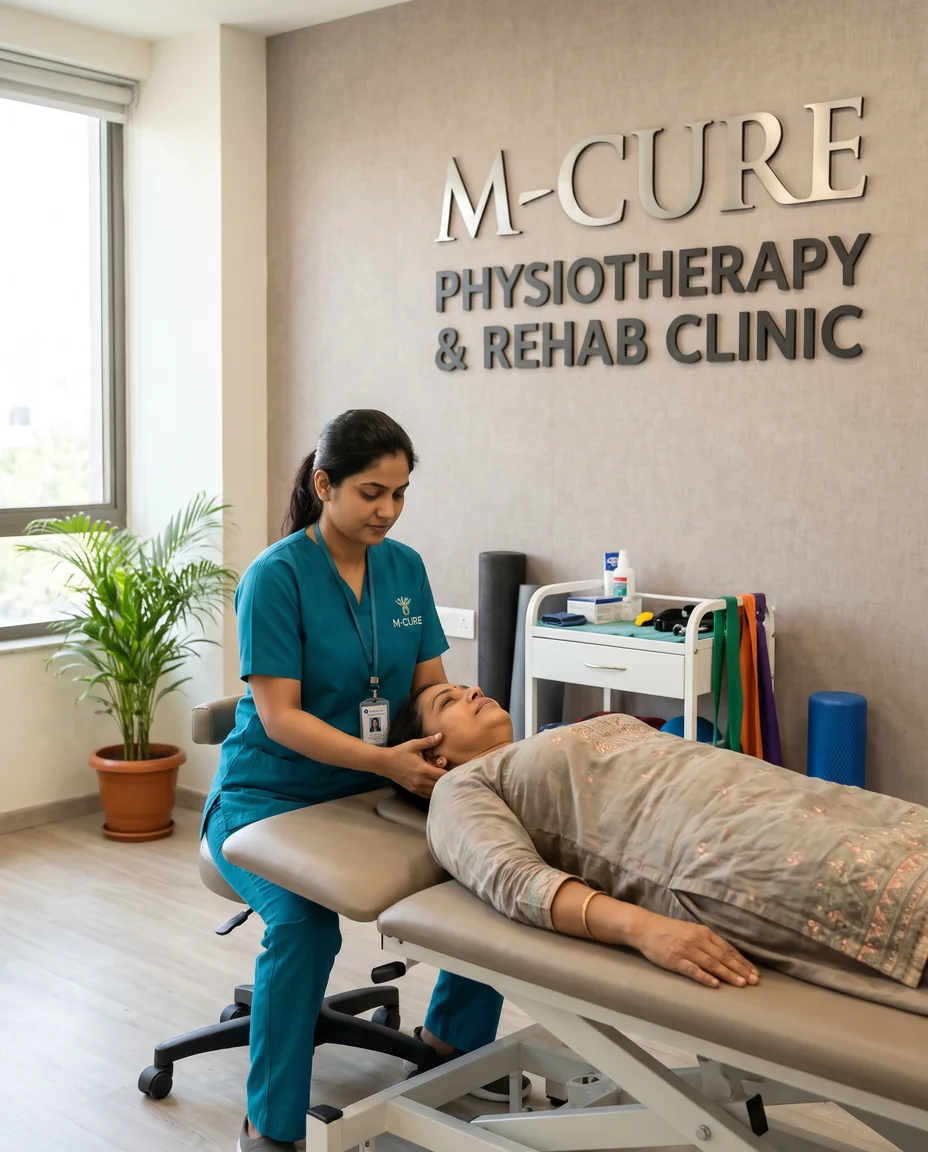
The M-CURE 4-Stage Spine Recovery Protocol

1

The McKenzie Method (MDT) Mechanical Diagnosis

We assess how your spinal symptoms respond to repeated movements in different directions:

  • Identifying Directional Preference. We identify whether your symptoms improve with repeated extension (bending backward) or repeated flexion (bending forward).
  • Observing Centralization. Our goal is to bring radiating pain out of your calf, thigh, and buttock back toward the center of your lower back. Centralization is a reliable clinical sign of disc recovery.
  • Classifying the Mechanical Problem. We categorize your condition as a Derangement, Dysfunction, or Postural Syndrome to select the most effective treatment approach.
2

Spinal Decompression & Segmental Mobilization

For patients with acute nerve compression or severe joint stiffness, our therapists use gentle hands-on techniques:

  • Manual Traction & Axial Decompression. Gently widening the intervertebral spaces to lower pressure inside the discs.
  • Maitland Passive Mobilizations. Mobilizing stiff thoracic, lumbar, and sacroiliac joints to distribute movement evenly across your whole spine.
  • Neurodynamic Mobilization (Nerve Flossing). Gently sliding the sciatic and femoral nerves through surrounding tissue tunnels to release adhesions and reduce nerve sensitivity.
3

Deep Core Stabilizer Reconditioning

General abdominal exercises like crunches or sit-ups place high compressive loads on healing discs. Instead, we focus on deep core stabilizers:

  • Transversus Abdominis Retraining. Teaching precise, coordinated activation of the deep abdominal wall alongside natural diaphragmatic breathing.
  • Multifidus Muscle Activation. Re-educating the deep, segmental back muscles that directly stabilize individual lumbar vertebrae.
  • Neutral-Spine Core Strengthening. Progressing through safe, spine-supported exercises—such as bird-dogs, modified side planks, and glute bridges—that build endurance without twisting or loading the lower back.
4

Hip-Hinge Mechanics & Workplace Ergonomics

We ensure that the improvements gained during treatment transfer into your daily routine:

  • Hip-Hinge Movement Retraining. Teaching you to bend, squat, and lift using your strong hip joints and gluteal muscles rather than rounding your lumbar spine.
  • Workplace Posture Adjustments. Providing personalized guidance on desk height, lumbar support, and monitor placement for professionals working long hours in Moshi and Bhosari.
  • Safe Lifting Strategies. Teaching industrial workers and active adults how to carry and lift objects safely to protect their spinal discs.

Why Choose M-CURE for Back Pain Relief in Moshi?

Avoiding Unnecessary Surgeries. The majority of slip disc and sciatica cases do not require surgery. Our structured mechanical protocols help patients recover conservatively.
Certified Mechanical Assessment. Our team uses recognized clinical assessment methods (such as the McKenzie MDT framework) to identify the specific movements that help your back, rather than relying on generic exercises.
Local, Ground-Floor Accessibility. Located at Rama Heights on the Nashik-Pune Highway, Sector 4 PCNTDA, our clinic is easy to reach for residents of Moshi, Spine Road, Bhosari, Chikhali, Charholi, and Alandi.
Long-Term Preventive Education. We equip you with the practical knowledge, posture corrections, and self-treatment exercises needed to keep your back healthy and prevent future flare-ups.

Frequently asked questions

Can a herniated disc (slip disc) heal without spinal surgery?

Yes. Clinical studies confirm that over 85% of lumbar disc herniations respond successfully to conservative mechanical physical therapy. Targeted directional preference exercises take pressure off the nerve root, allowing the herniated disc material to resorb naturally.

Why does my lower back pain shoot down my leg into my calf and foot?

This is sciatica, or lumbar radiculopathy. It occurs when a herniated disc, osteophyte, or swollen facet joint compresses the L4, L5, or S1 nerve roots in the lower spine, sending radiating pain along the path of the sciatic nerve.

Should I stay in bed if I have acute lower back spasms?

Strict bed rest beyond 24 to 48 hours is detrimental to spinal recovery. Prolonged rest increases joint stiffness, weakens core musculature, and prolongs disability. Gentle walking and directional exercises help promote recovery.

How quickly can I expect relief from sciatica symptoms at M-CURE?

With strict adherence to directional preference exercises, many patients experience a "centralization" of pain—where pain retreats from the foot and calf back up into the lower back—within 3 to 6 sessions.

Is heat therapy or ice better for severe lower back pain?

Use cold therapy during the acute phase (the first 48 hours after injury) to numb sharp pain and reduce localized inflammation. Apply moist heat to chronic aching and stiff paraspinal muscles to improve local tissue circulation.

What is the McKenzie Method used at your Moshi clinic?

The McKenzie Method (MDT) is a system of musculoskeletal assessment based on how your symptoms respond to repeated, directional movements. Finding your specific directional preference allows us to centralize and resolve radiating spinal pain.

Can lower back pain cause weakness in the foot (foot drop)?

Yes. Significant compression of the L4 or L5 spinal nerve root can impair the motor signals to the muscles that lift your foot. This condition requires immediate physical therapy and medical evaluation.

How do I tell if my back pain is coming from my kidneys or my spine?

Kidney pain presents as a deep, steady ache in the upper flank, below the ribcage, and does not change with body movement, twisting, or bending. Spinal pain directly varies in intensity with physical posture, bending, sitting, or walking.

Which core exercises should I avoid during an acute back pain flare-up?

Avoid traditional sit-ups, crunches, and Roman-chair hyperextensions, which place high compressive and shear loads on vulnerable lumbar discs. We prioritize neutral-spine core training like bird-dogs and modified planks.

Can poor workstation ergonomics cause recurring lumbar back pain?

Yes. Prolonged sitting with a rounded lower back flattens the natural lumbar lordosis, increasing intradiscal pressure by up to 40% compared to standing. We help patients set up safe, spine-supported workstations.

Ready to Take the First Step Towards Better Movement?

Connect with M-CURE Physiotherapy and Rehab Clinic to discuss your physiotherapy and rehabilitation needs.

Visit M-CURE in Moshi

M-CURE Physiotherapy and Rehab Clinic
Rama Heights, Plot No. 278, Nashik - Pune Highway, Near Aahar Veg Restaurant, PCNTDA, Sector Number 4, Moshi, Pimpri-Chinchwad, Maharashtra 411070

+91 92841 33562

Serving Moshi, Spine Road, Bhosari, Chikhali, Charholi, Alandi, Dighi, Talawade and nearby areas.

Opening hours: [to be confirmed by the clinic]

Google Reviews

Read patient reviews or share your experience with M-CURE.

View on Google
WhatsApp
CallWhatsAppBook Appointment